

Part I - Japan Named and Owned It. Why Hasn't Singapore?
- Julie O'Connor
- Jun 1
- 7 min read

Updated: Jun 2

It's not the first time that Singapore's own press has written about sontaku. But this latest piece went further than most, applying the concept to Keir Starmer's Britain, to Trump's America, even to FIFA. It traced the idea all the way back to Max Weber and the scandals of the Abe administration. And then, having looked everywhere, it stopped. Singapore, the one place its own readers actually live, was left unexplored.
If sontaku explains how power protects itself in Japan, in Britain, in America, why does applying the same question to Singapore feel so uncomfortable? Was it an oversight? Or was it, ironically, sontaku?
What It Means
For those who don't know, Sontaku 忖度 means acting on what a superior wants without ever being asked. No order needs to be given, no memo needs to be sent, no phone call needs to be made. Just a culture so attuned to protecting those at the top that people learn to filter out anything that might cause discomfort for those above them. Not because they are told to, because this is what they see gets rewarded.
It became Japan's word of the year in 2017, after scandals showed how subordinates had delivered what their leaders wanted, while keeping those leaders completely in the clear. Superiors can say they never gave the order. Subordinates can say they were just doing their jobs. Nobody is lying, nobody is accountable and the system works exactly as it is supposed to.
The problem being that if you cannot see sontaku, you cannot name it. And if you cannot name it, you cannot change it.
The Two Things Sontaku Runs On
Sontaku runs on two things most people will recognise immediately. Fear and Favour. Fear of consequences, of losing access to powerful people, of damaging your career, or becoming the person everyone blames for making things difficult. And favour. Wanting to get ahead, staying on the right side of the right people, protecting a relationship that matters, not wanting to be the one who rocks the boat.
The most dangerous version is when people can no longer tell the difference between the two. Going along just feels natural and nobody has to say don't investigate, don't ask, protect this person, or go after that one. People deliver what the institution expects without being instructed.
I'm not suggesting that sontaku is always harmful, in its gentler form it is simply reading the room, being considerate and keeping things running smoothly. But it becomes genuinely dangerous when it takes hold in the places that are supposed to keep power honest, the press, the regulators and the institutions that are meant to work for everyone.
Afraid to Poke the Bear
Anyone who has sat in a meeting where a senior figure's half-formed opinion quietly becomes the whole room's conclusion will recognise this immediately. It happens everywhere. But in Singapore, where saving face within hierarchies runs deep, it has particular consequences.
Open disagreement with a superior, especially in front of others, remains rare. What you get instead is a particular kind of silence. Not necessarily agreement, but the performance of agreement. Junior staff who work out what the minister wants before he has said it. Middle managers who quietly reshape proposals to fit what the MD is likely to prefer. Committee members who wait to see which way the chairman leans before they say anything at all.
A Singapore journalist surveying the world for sontaku could look closer to home and ask: are the rising number of Singaporeans seeking asylum abroad doing so because of political and civil concerns, as advocates suggest? And why is Singapore's legal profession losing young talent? One in three new lawyers say they are likely to leave within three years, citing overwork, poor culture, and a lack of mentorship. Concerns serious enough to be raised by the Chief Justice himself. Are those leaving, casualties of a system that has made the cost of speaking up, or simply refusing to go along, too high to bear? The question is not why they left, it's what it tells us about what they left behind.
The journalist could also ask whether sontaku might explain why certain Singapore scandals appear not to have been independently investigated with the same fervour as others. Perhaps the irony is that local journalists don't even need to be told not to poke that bear. They have seen what happens when local and international outlets, journalists, bloggers, and public figures push into uncomfortable territory. In different ways, all have learned that lesson at some cost.
They Did Poke the Bear
Former Singapore President Devan Nair didn't use the word sontaku. But in 1994 he described it precisely, writing that the bread of those who conform is handsomely buttered, that keeping your head down could give you one of the best living standards in Asia, while raising it could cost you your job, your home, and the attention of the Internal Security Department.
Lee Hsien Yang, Lee Kuan Yew's youngest son, has said that Singapore's financial system has repeatedly played a part in international corruption scandals, that the world needs to look beyond Singapore's "bold, false assertions" and see Singapore's role as a facilitator for arms trades, dirty money, drug money, and crypto money. Whether you agree with him or not, the concerns he raises are serious. But if Singaporeans are living and working inside a culture of sontaku, who will dare to speak up? Even if they witness the facilitation of money laundering or corruption, who is going to blow the whistle on anything hidden, when they have watched what happens to those who raise their heads?
Don't Go There...
What Singaporeans sometimes refer to as Out of Bounds or OB markers is, in my view, sontaku by another name. Journalists, academics, and public figures learn through observation which subjects invite scrutiny, and which invite consequences. The line doesn't need to be written down because most already know where it is. And invisible boundaries are much harder to fight than visible ones. At least explicit censorship leaves fingerprints.
A journalist who doesn't file a story because an editor told them not to is being censored. That is visible and can be challenged. But a journalist who never even pitches the story, because years inside a media landscape shaped by its closeness to power have taught them which questions are welcome and which are not, that journalist is practicing sontaku. No call has to be made or warning issued, the story simply never exists.
In Singapore, where media ownership is concentrated and the distance between the press and the establishment has historically been narrow, this is not a conspiracy, it's a culture. The press seems to know who the heroes and villains are without being told. The same press that published a piece scouring the world for sontaku, from Tokyo to Washington to Westminster, couldn't see itself in the mirror. Mirror, mirror on the wall... it seems nobody is looking at all.
A press that has learned what not to ask is more dangerous than one that has been told what not to print. One can be challenged. The other can't even be seen.
Start Them Young
But sontaku doesn't start in newsrooms or government offices, arguably, the lessons start much earlier. In Singapore, children are taught that institutions deserve respect, that authority should be approached through the right channels, and that stability matters. None of these are bad lessons on their own. But without the equal lesson that institutions can be wrong, that speaking up is sometimes the right thing to do, and that sometimes the most loyal thing you can do is say something, they lay the groundwork for a lifetime of sontaku.
The child who learns that keeping your head down is the right thing to do becomes the employee who doesn't raise concerns. That employee becomes the manager who doesn't ask difficult questions. That manager becomes the leader who is never told the truth. And the leader who is never told the truth becomes the person at the top of a cover-up they may not even know exists.
Japan Had the Courage to Name It
The uncomfortable truth is that any leader who doesn't actively make it safe to hear difficult things will, over time, simply stop hearing them. And once that happens, it doesn't matter whether they meant it to or not, eventually it becomes the culture.
Japan at least had the courage to name sontaku, investigate the scandals around it, and tighten its rules. But you cannot pass a law that changes a culture. The instinct behind it runs deeper than any rulebook. Japan's experience is instructive, naming the problem is a start.
Nobody Called It Sontaku
Singapore has arguably been living with sontaku for decades without ever calling it that. But whatever name it has gone by, the dynamic is the same. What follows is just a small selection of what is out there publicly, none of it uses the word sontaku. But if it walks like a duck and quacks like a duck, it's probably a duck.



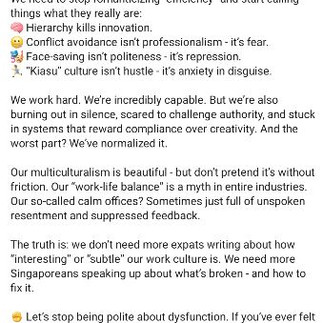


The real question for Singapore's leaders is not whether sontaku exists there. It is whether any of them are willing to call it out. Because the scandals that sontaku conceals do not stay concealed forever. When they surface, and they will, the question will not only be who knew. It will be who created the conditions in which nobody felt they could say so. That question will have no comfortable answer.
Why did no one come forward and expose the Keppel bribery scandal sooner? Who knew about the activities of the $3 billion money laundering gang and said nothing? Who knew about the Speaker's affair, which placed him in a position of conflict, but didn't disclose it to Parliament? Who knew that a writ had been served on a SGX-listed group, which along with a whistleblower submission, was never disclosed to the market? Why did no one come forward to expose that a whistleblower was offered a financial incentive to hand over evidence and retract complaints? Or that another was coached to omit information from a submission to a Singapore GLC?
And given the KPMG scandal currently engulfing Australia, which Singapore's press are perfectly happy to report on, why are they not asking how many whistleblowers are discredited or coerced into silence closer to home?
These are not rhetorical questions. They are exactly the questions a press operating without OB markers should already be asking.
Singapore's press could ask the uncomfortable questions far more often than it does, and that it doesn't is itself worth examining. If they are simply too afraid, is that because chickens are periodically killed in Singapore to remind the monkeys what happens 杀鸡儆猴?

In Part II — No Instruction Is Necessary — I look at what sontaku looks like from the inside. What happens when you refuse to practise it. And what the silence of institutions feels like when it is directed at you personally.
The author submitted whistleblower reports to the Audit Committees of two SGX-listed companies and raised concerns with DBS, MAS, SGX, the Attorney General's Chambers, the Corrupt Practices Investigation Bureau, the Prime Minister's Office, and several Presidents. Responses from DBS, MAS, and the PMO are on public record.


Comments