

The Scrutiny Gap: Who Decides Who’s Accountable?
- Julie O'Connor
- Jan 16
- 4 min read

Updated: Jan 17


Imagine two cases of equal seriousness landing on the same desk. One is pursued with relentless scrutiny. The other is quietly set aside, because the person involved has the “right” connections. That disparity would do more to destroy public trust than the alleged wrongdoing ever could.
The question is whether this scenario is hypothetical in Singapore? Even if the 'perception' is that accountability depends on who you are rather than what you have done, what message would that send from the top to regulators, to boardrooms, and to anyone weighing whether speaking up is worth the risk?
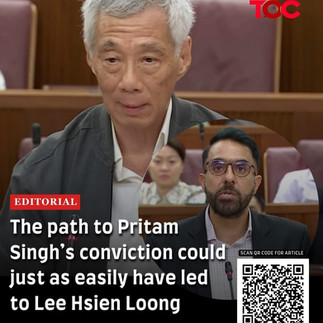
Consider the disparity highlighted recently in an article published by The Online Citizen:
"This editorial does not argue that Lee is guilty of perjury, particularly since he was never subjected to a COP hearing. It argues something more fundamental: the outcome of Singh’s case is the product of process.
Singh was only convicted because a COP was convened, and the inquiry aggressively focused on party leadership. The prosecution followed from that. In contrast, Tan’s affair was handled privately, without institutional investigation, shielding others from comparable exposure.
In short, Singh’s downfall is not solely about personal guilt—it is about how Parliament chose to act."
Then there is the high-profile dispute between Lee Hsien Yang and Lee Hsien Loong, which ultimately led to Lee Hsien Yang seeking exile. Former Prime Minister Lee Hsien Loong made a statutory declaration concerning 38 Oxley Road, while Lee Hsien Yang later gave a materially different account. Rather than subjecting both versions to independent and equal scrutiny, the focus appeared to shift quickly to accusing Lee Hsien Yang of “lying” simply because his account conflicted with that of his brother.
Once again, the question was not whether the statutory declaration itself should be rigorously examined, but why such scrutiny seemed to apply in only one direction. The contrast is difficult to ignore: Lee Hsien Loong did not appear to face the same level of independent examination that Pritam Singh has been subjected to.
Lee Hsien Yang described "I have now been condemned in Parliament and the press without due process.” and went on to question how there could be fair and proper investigations or a fair trial in what is clearly a politically motivated prosecution."
With the UK authorities later granting Lee Hsien Yang asylum under the UNHCR framework, one can assume this suggests they found his account credible.
And that brings me, finally, to my own experience.
At the material time, the Attorney-General was the head of the law firm representing the client at the centre of my complaint. The Minister for Law, a former colleague from the same firm, appears to have been among the lawyers acting for that client. There is nothing in this to suggest any wrongdoing on their part. But I believe they would be conflicted if any investigation were undertaken.
After raising serious concerns involving a SGX-listed group, including but not limited to a whistleblower and witnesses having been induced to retract complaints, and where a writ containing sworn allegations of fraud was never disclosed to the market, I received the following response from Singapore’s Police Force:
“CAD will not take further action on your complaint given that there is insufficient evidence to establish that a criminal offence has been committed. The decision has been made in consultation with the Attorney-General’s Chambers.”
Notice the efficiency. “Insufficient evidence”, determined before any investigation was carried out.
This, despite serious concerns raised independently by NUS Professor Mak Yuen Teen in relation to the same group of companies, and despite Government-Linked Bank DBS holding an estimated $637 million exposure, followed by OCBC at $300 million and UOB at $166 million, when the group went on to collapse.
Was no investigation deemed necessary because someone had bought the evidence and silence? Do we know if company funds were used to hide information from investors?
"Who is this director of the parent company (i.e., Ezra) who was paid the refundable deposit that was unsecured and interest free? What was the purpose of this refundable deposit? When was it disclosed, if at all? Was it repaid to the company?"
Astounding? Alarming? Or simply… efficient?
This is what sustained mistrust does. It breeds suspicion and forces uncomfortable questions. Without genuinely independent oversight, how easy is it to decide who becomes the villain and who remains untouchable? How easily can figures like Lee Hsien Yang, Pritam Singh, Lee Suet Fern, and myself be framed as the problem, while those with the “right” connections remain comfortably beyond scrutiny?
If you only ever look for dirt under the rugs of some people, and never others, that is not equitable scrutiny. It is selective enforcement dressed up as governance.
Those who believe that stripping a title from the Leader of the Opposition will restore integrity to Singapore’s political system misunderstand what integrity requires. It is not built through symbolic gestures but demonstrated when those with power are willing to accept accountability and admit mistakes, especially when doing so involves personal risk.
In my own experience, no board member of EZRA Holdings or Triyards, and no one from DBS, spoke up to say that what was happening to the investors of the SGX listed group, or my family was wrong. When silence is rewarded and truth is punished, responsibility cannot credibly be placed on the opposition.
So, the real question is this: who benefits when no one dares to speak?
For now, at least for the weekend, let us pretend that, in this twilight zone, integrity and public trust have been fully restored, now that the villain has been duly stripped of his title, the watchmen will now right all wrongs, and accountability has magically reappeared. If only courage were on tap.
Sigh! I expect reality will hit home again on Monday.


Comments